Carlo Brooks · 4 November 2026
Seasonal Demand Forecasting Models Derived from Historical Appointment Logs in Beauty Enterprises
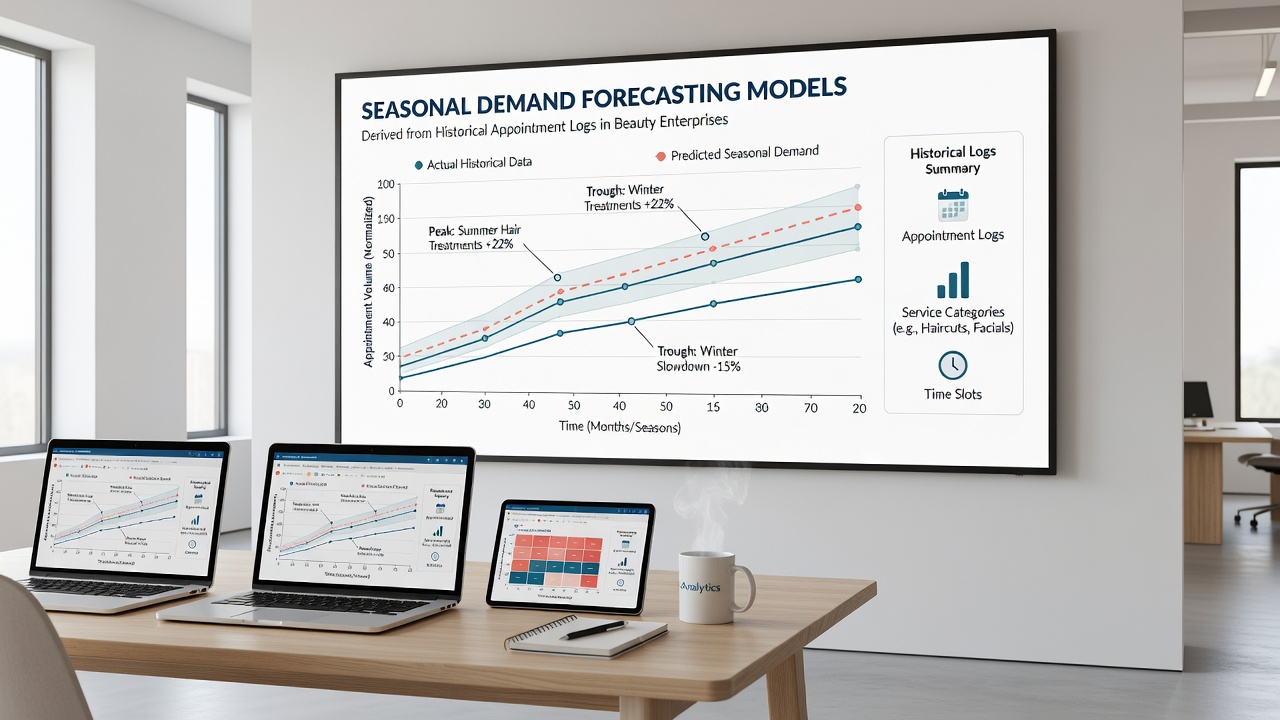
Beauty enterprises rely on historical appointment logs to construct seasonal demand forecasting models that predict client volumes across different times of the year, and these systems draw directly from timestamped booking records that capture service types, durations, and repeat patterns. Data analysts process logs spanning multiple years to identify recurring peaks during holiday periods or slower stretches in off-seasons, while statistical techniques such as time-series decomposition separate underlying trends from cyclical fluctuations and random noise.
Extracting Patterns from Appointment Data
Appointment logs contain fields including date, time, service category, staff assignment, and cancellation rates, and researchers aggregate these entries into weekly or monthly buckets to reveal seasonal signatures. For instance, logs from independent salons often show elevated bookings for hair coloring services in the weeks leading into December, whereas nail and spa treatments spike ahead of summer events, and analysts apply moving averages alongside regression models to quantify these shifts with measurable accuracy.
Those who manage beauty venues note that raw logs require cleaning steps to remove outliers caused by one-time promotions or external disruptions, after which autoregressive integrated moving average models or exponential smoothing methods generate forecasts that adjust for both trend and seasonality components. Evidence from industry reports indicates that enterprises maintaining at least three years of consistent digital records achieve tighter prediction intervals compared with those using shorter datasets.
Model Construction Techniques
Forecasting models typically begin with decomposition of the appointment series into trend, seasonal, and residual elements, and practitioners then fit parameters using software packages that minimize forecast error metrics such as mean absolute percentage error. Seasonal indices derived from historical November and December volumes help scale base demand upward by 25 to 40 percent in many urban markets, while January figures frequently require downward adjustments reflecting post-holiday reductions.

Advanced approaches incorporate external regressors such as local event calendars or temperature records, yet the core remains anchored in the appointment history itself. Studies conducted by academic teams at institutions across North America demonstrate that hybrid models combining log-derived seasonality with machine learning layers can reduce inventory overstock incidents in supply ordering by aligning staff schedules and product purchases more closely with projected client flows.
Implementation Across Different Enterprise Types
Chain-operated beauty salons integrate these models into centralized dashboards that push daily staffing recommendations to individual locations, whereas independent stylists apply simpler spreadsheet-based versions updated monthly from their own booking software exports. In both cases, the models flag upcoming periods when demand for specific services exceeds average capacity, prompting advance hiring of temporary technicians or targeted marketing campaigns aimed at lower-demand weeks.
According to data compiled by Statistics Canada, personal care service establishments in metropolitan areas experience pronounced seasonal variance tied to cultural and climatic cycles, and logs from these venues supply the granular inputs needed to translate national-level observations into venue-specific forecasts. Similar patterns appear in reports issued by the Australian Bureau of Statistics, which track appointment-derived metrics for hairdressing and beauty treatment businesses operating in variable regional climates.
Operational Adjustments and Resource Planning
Once forecasts are generated, managers translate projected appointment counts into concrete actions including shift scheduling, inventory replenishment, and promotional timing. Historical logs reveal that color service demand rises sharply in October and November, prompting enterprises to pre-order additional dye stock and extend operating hours on weekends. Meanwhile, slower periods identified in February logs allow for equipment maintenance windows without disrupting client throughput.
Enterprises that update their models quarterly with the most recent appointment data maintain relevance as consumer preferences evolve, and cross-validation against actual realized volumes in subsequent seasons confirms whether parameter adjustments improve accuracy. Observers note that venues incorporating cancellation and no-show rates into the models further refine capacity estimates, since these factors directly influence effective demand.
Conclusion
Seasonal demand forecasting models built from historical appointment logs provide beauty enterprises with structured methods for anticipating client volumes and aligning resources accordingly. Continued accumulation of digital booking records supports iterative refinement of these models, while integration with broader economic indicators from sources such as government statistical agencies extends their utility beyond single-location operations. As appointment systems evolve, the precision of derived forecasts continues to depend on consistent data capture and disciplined analytical application.